How AI can really help - it depends on how you use it
AI tools are only as good as the input you give them. How flat-finder.ch turns your preferences into better results - and why hard facts about surroundings, commute, and livability beat guessing what you want.


Part of the flat-finder.ch build-in-public series. Find every article in the project hub.
You've probably noticed that every product these days has "AI-powered" in its tagline. Chatbots, image generators, code assistants - and now, real-estate search.
But here's something you don't hear often: AI is only as useful as the data it works with.
Ask a search tool "find me a flat in Zürich" and you get thousands of results sorted by nothing useful. Tell it "I need 2.5 rooms, max 18 minutes to my office by tram, balcony is important, budget around 2500 CHF" - now you're getting somewhere.
The difference isn't the algorithm. The difference is how much relevant information the system has to work with.
And that's the insight behind flat-finder.ch: good AI doesn't guess what you want. It takes what you tell it matters and matches it against as many hard facts as possible.

The flat-finder.ch dashboard - your search criteria, your listings, your scores.
The problem with listing-only data
Most real-estate platforms show you what the landlord tells you: rooms, price, floor, maybe a photo and a paragraph of text. That's it. You're supposed to decide whether a flat is right for you based on that.
Then you open a second tab to check the commute. A third to see if there's a supermarket nearby. A fourth to look at the neighborhood on street view. You're doing the data enrichment yourself, manually, for every listing.
That's where AI should help.
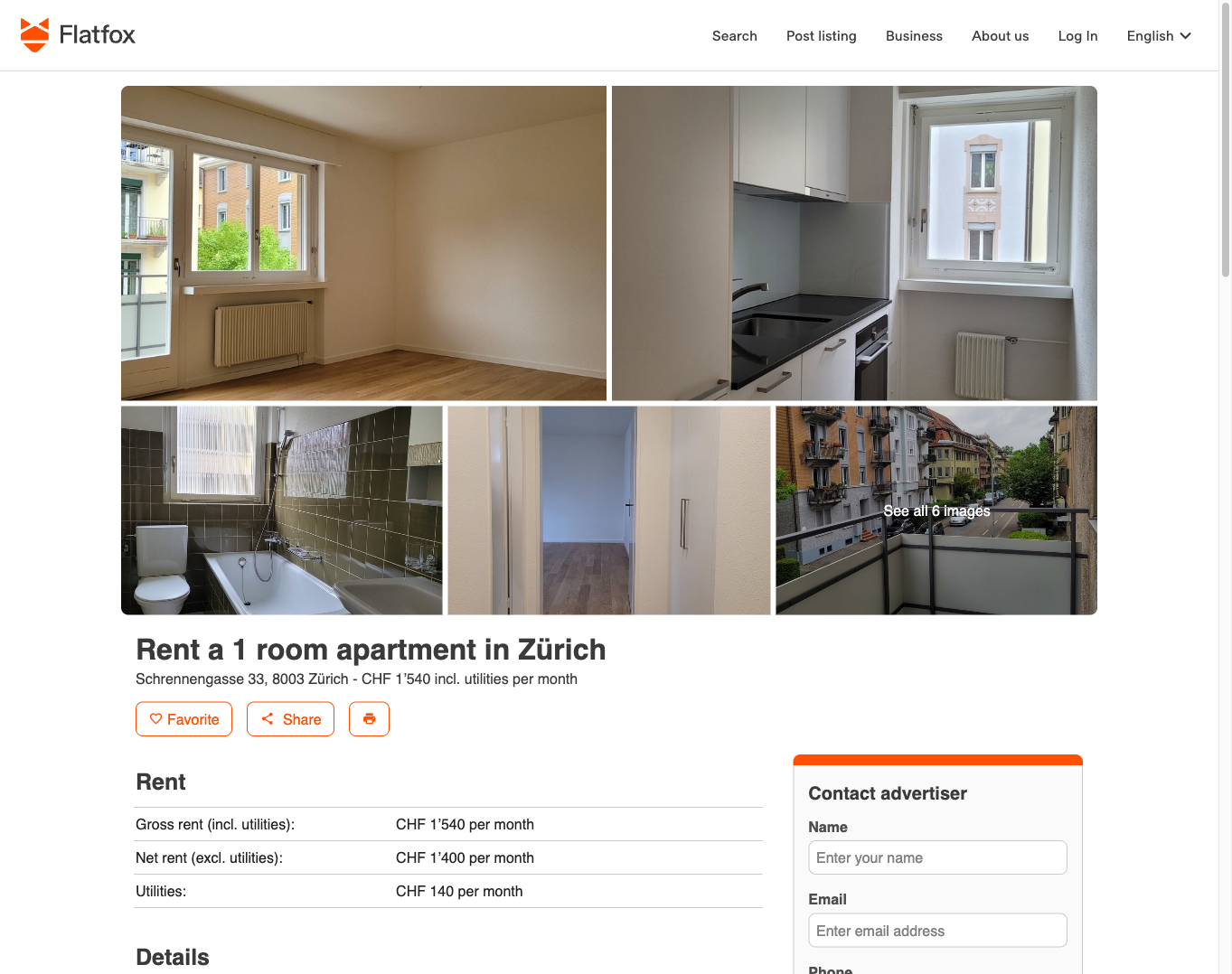
Traditional platforms show you what the landlord provides: rooms, price, floor, photos. No commute times, no neighborhood scores, no hard facts about what matters to you.
What flat-finder.ch does today
The Match Score starts with your preferences. You tell the system what matters - price, rooms, commute, outdoor space, pet-friendliness - and how much each matters. Then it scores every listing against those criteria.
No black box. No "we learned you like top floors from your click history." Just explicit criteria, explicitly weighted, applied consistently.
It works. But the data it's working with is still mostly what the listing provides. And listing text is thin.
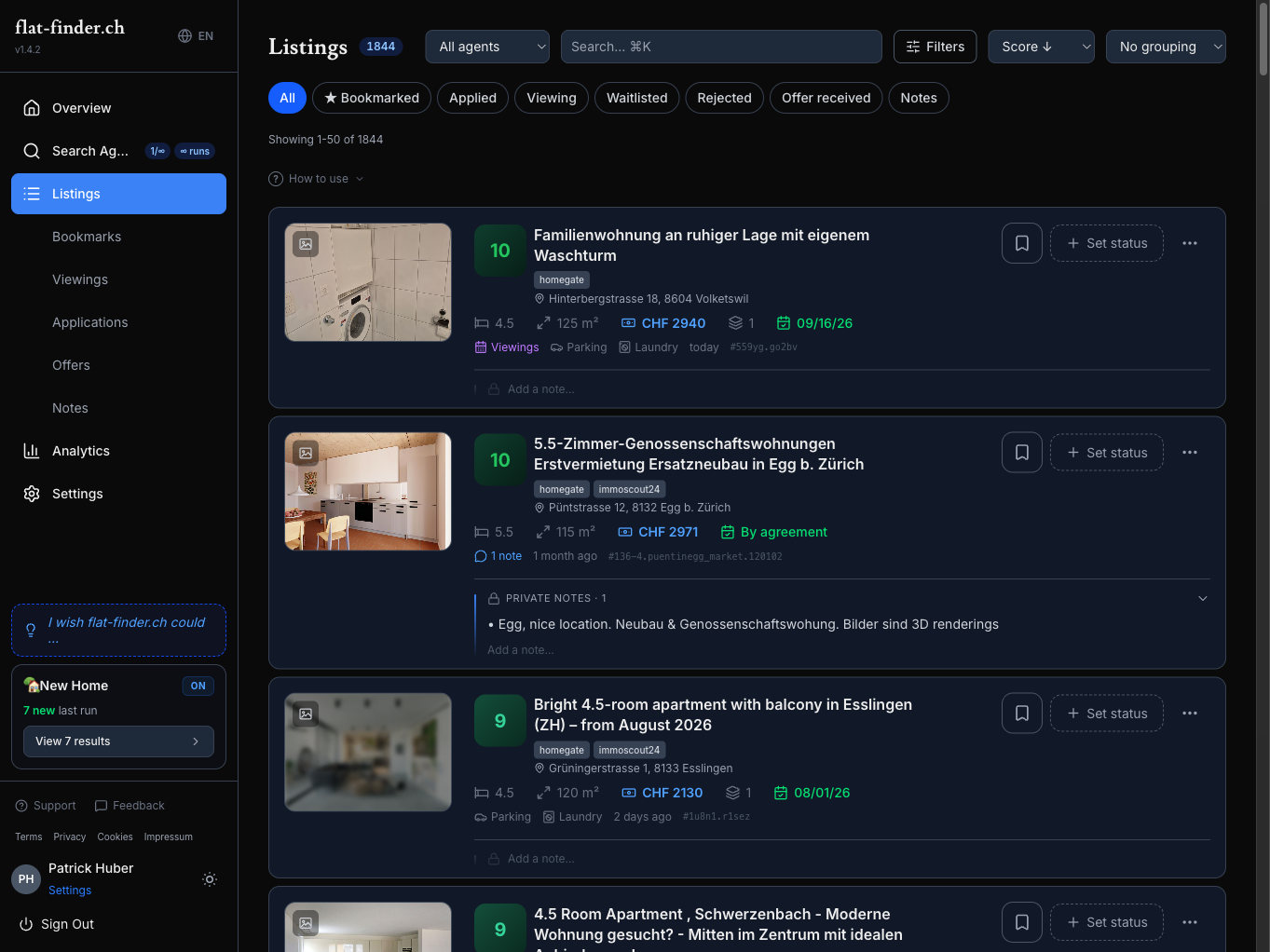
Every listing scored against your explicit criteria - sorted by relevance, not price or date.
Where the real value is: surrounding context
Here's what's missing from every listing you've ever seen:
- Commute time >> Not "near tram stop," but "18 minutes to your office at Bahnhof Oerlikon." Swiss public transport APIs can calculate this precisely for any address.
- Surroundings >> Bars, schools, parks, nature, woods, supermarkets. OpenStreetMap and similar data sources know what's around every building.
- Noise level >> A rough estimate based on proximity to main roads, nightlife districts, and construction zones.
- Safety >> Crime rate data, where available, per district.
- Taxation >> Swiss cantons have very different effective tax rates. A CHF 90'000 salary might net you noticeably more in Zug than in Zürich. Tax calculator APIs can estimate your take-home pay for any address.
- Demographics >> Rate of foreigners, average age, family vs. single households per district. Useful if you want a certain kind of neighborhood vibe.
- Photo intelligence >> Vision models can analyze listing photos to assess building condition, renovation quality, whether a balcony is actually usable, or if a window faces a busy street or a quiet courtyard.
None of this is in the listing. All of it matters when you're deciding where to live.
Why user steering beats behavioral tracking
You might have seen products that try to "learn your preferences" by tracking clicks, dwell time, and scroll patterns. The pitch is: the system knows you better than you know yourself.
There's a problem with that approach for flat hunting: you're not here that long.
A typical flat search lasts a few weeks. Maybe you look at 50-100 listings. That's not enough data for a behavioral model to be useful. It's not enough for you to be sure what you want, let alone a machine.
A better approach: give the user the steering wheel.
You know what matters to you. You know you need to be near a park because you have a dog. You know you want a quiet street because you work from home. You know you don't care about the year of construction.
The system shouldn't guess. It should let you set priorities and then match listings against the richest set of facts it can gather.
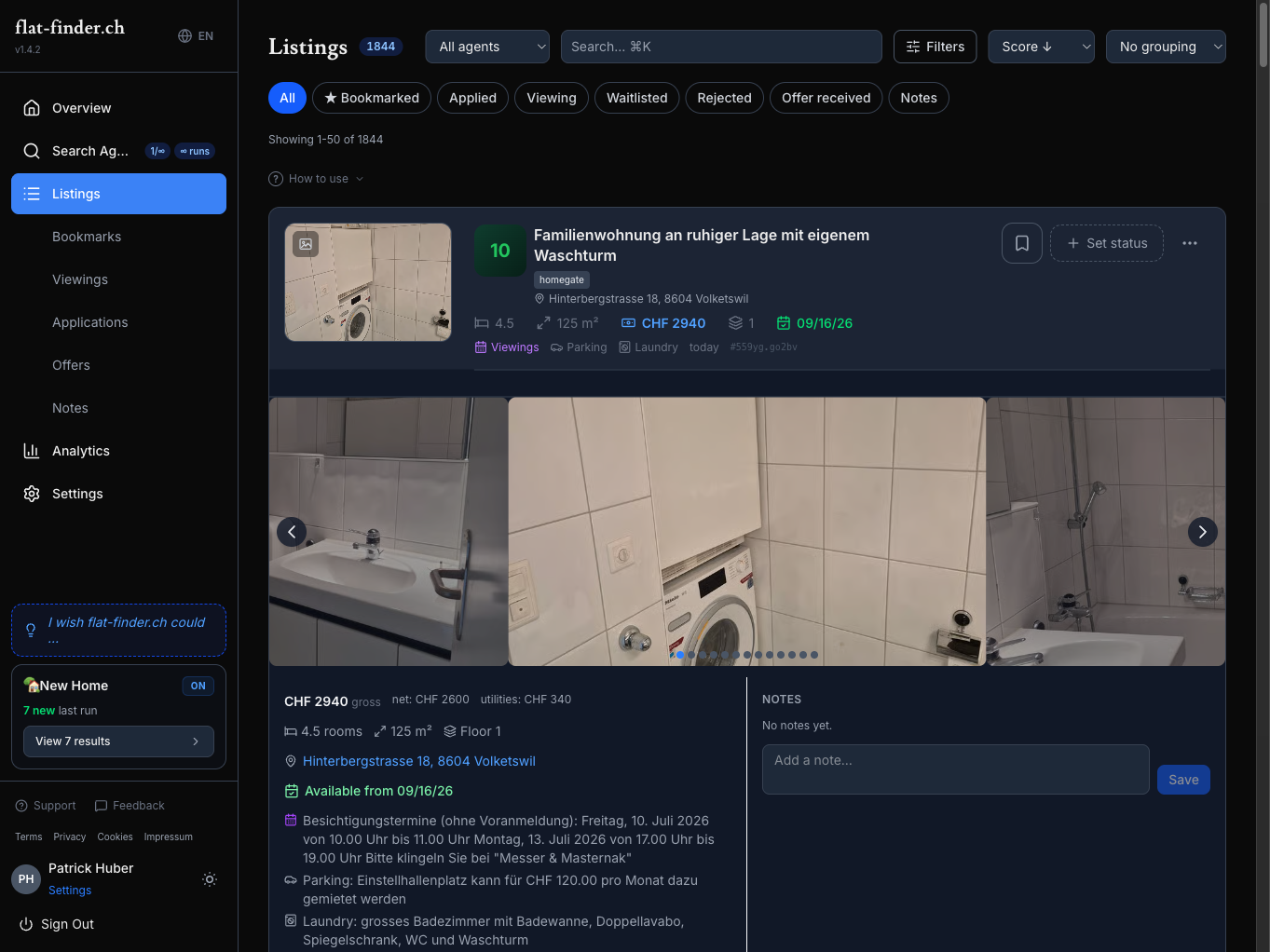
Score 10 - Perfect match. Every listing shows why it matched your criteria, with details about viewings, amenities, and timing.
What the future looks like

The Match Score will improve as more data sources become available. The philosophy stays the same: you steer, the system calculates.
Here's what's achievable with data that already exists:
- Public transport APIs >> Real commute times from any address to your workplace, including transfers and departure time. Not "near a station" but "16 minutes via tram 9, one transfer."
- Neighborhood scoring >> Walking distance to parks, schools, shops, bars, gyms. Weighted by what you care about. Love hiking? The system scores flats near woods and nature reserves higher.
- Vision-based assessment >> Analyze listing photos for building condition, renovation quality, balcony size, street-facing vs courtyard-facing windows. Extract facts from images that the listing text omits.
- Noise estimation >> Combine proximity to main roads, nightlife areas, and construction data for a rough livability score. Rough, but better than arriving at a viewing to discover your window faces a bar street.
- Safety and crime data >> Published statistics per district, weighted by your preference. Zero weight if it doesn't matter to you.
All of this is hard data. None of it requires tracking what you click. You tell the system what's important. It finds the facts. You make the decision.
The real takeaway
AI isn't going to decide which flat you rent. You will. But it can do the boring work - cross-referencing addresses with commute times, measuring distances to parks, estimating noise levels - so you can focus on what actually matters: walking through a place and feeling whether it's right.
The best AI tools don't replace your judgment. They give you more information to exercise it with.
A vague "find me a flat" will always produce vague results. Clear preferences + rich data = something worth looking at.
And if you want to test that, flat-finder.ch is free to use. Set your criteria, see what the scores look like, and tell me if it actually helps.