The Zürich rental pain
A field report from the Zürich rental market — mass viewings, dossier roulette, and the quiet tax on everyone's time. Why none of this is normal, and why we accept it anyway.


Part of the flat-finder.ch build-in-public series. Full index in the project hub.
If you've never searched for a flat in Zürich, this post will sound exaggerated. If you have, the only question is which paragraph you'll nod hardest at.
This is a field report. Not a complaint, exactly — more like a list of things we've all silently agreed to accept, even though none of them are actually normal.
1. The mass viewing
You apply to a listing online. Three days later you get an email: viewing on Tuesday, 18:30. Show up.
You show up. So do 40 other people.
Forty.
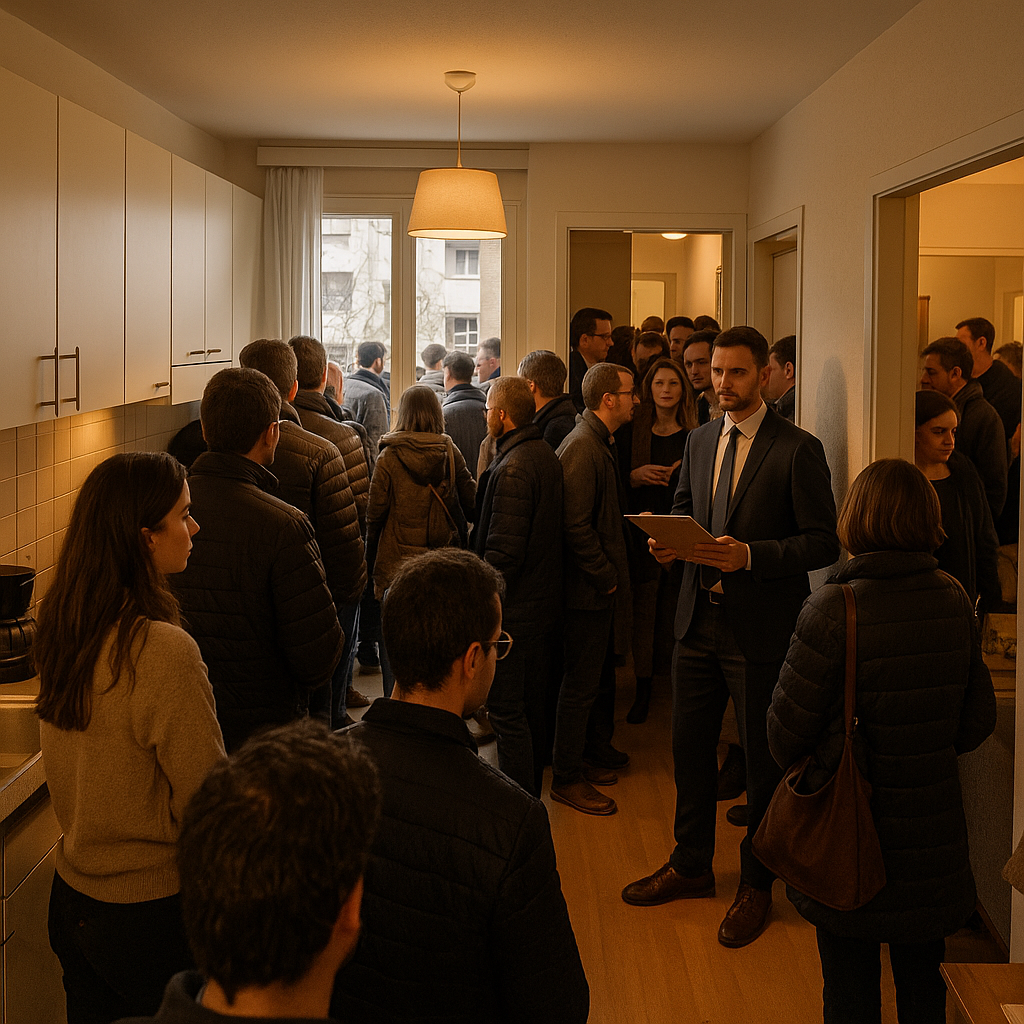
In a 78 m² 3.5-room flat where, structurally, about six humans can stand in the kitchen at the same time. The line snakes down the staircase. The agent has a clipboard. You shuffle through the apartment in 90 seconds, look at a balcony, try to evaluate whether the neighbors are quiet (impossible — there are 40 strangers murmuring in the hallway), and then you're back outside.
You go home and write an application. Salary slip, employer letter, ID, Betreibungsauszug, references, motivation paragraph. You attach a friendly photo. You email it within the hour because everyone told you the early applications get read.
You hear nothing. Two weeks later the listing disappears.
Repeat for the next flat. And the next. And the next.
2. The dossier as currency
In other markets, you apply for housing and your application is roughly: "Hi, can I live here? Here's how much I earn." In Switzerland, you submit a dossier.
A dossier is a small dossier of evidence proving you are a low-risk human being:
- Betreibungsauszug — official record from the debt enforcement office, certifying you don't owe money to anyone formally
- Lohnausweis or Arbeitgeberbestätigung — salary slip and/or employer letter, recent, ideally on letterhead
- Mietzinsdepot — assurance you can park 1–3 months of rent in a security deposit account
- Copy of ID / residence permit
- Reference from previous landlord — yes, often required
- Motivation letter — why this flat, why you
Each of these is reasonable in isolation. Together they form an asymmetric paperwork ritual: landlords ask, tenants comply, the cost is borne entirely by the applicant. Multiply by 15 applications and the dossier becomes a part-time job.
Most renters end up with a "dossier folder" they update once a month and ship out by email at every opportunity. It's a workaround for a market that demands too much of its applicants and gives them no leverage in return.
3. The opaque ranking
You search on Homegate, Flatfox, ImmoScout24. You set filters. You sort by date.
What gets shown to you is not actually the freshest, most relevant, best-matched listing for your criteria. It's a mix of:
- Paid placements — landlords or agencies that bought visibility
- Featured boxes — same thing, dressed up
- Algorithmic ranking — whose internals are not published, and which optimize for the platform's revenue, not your housing outcome
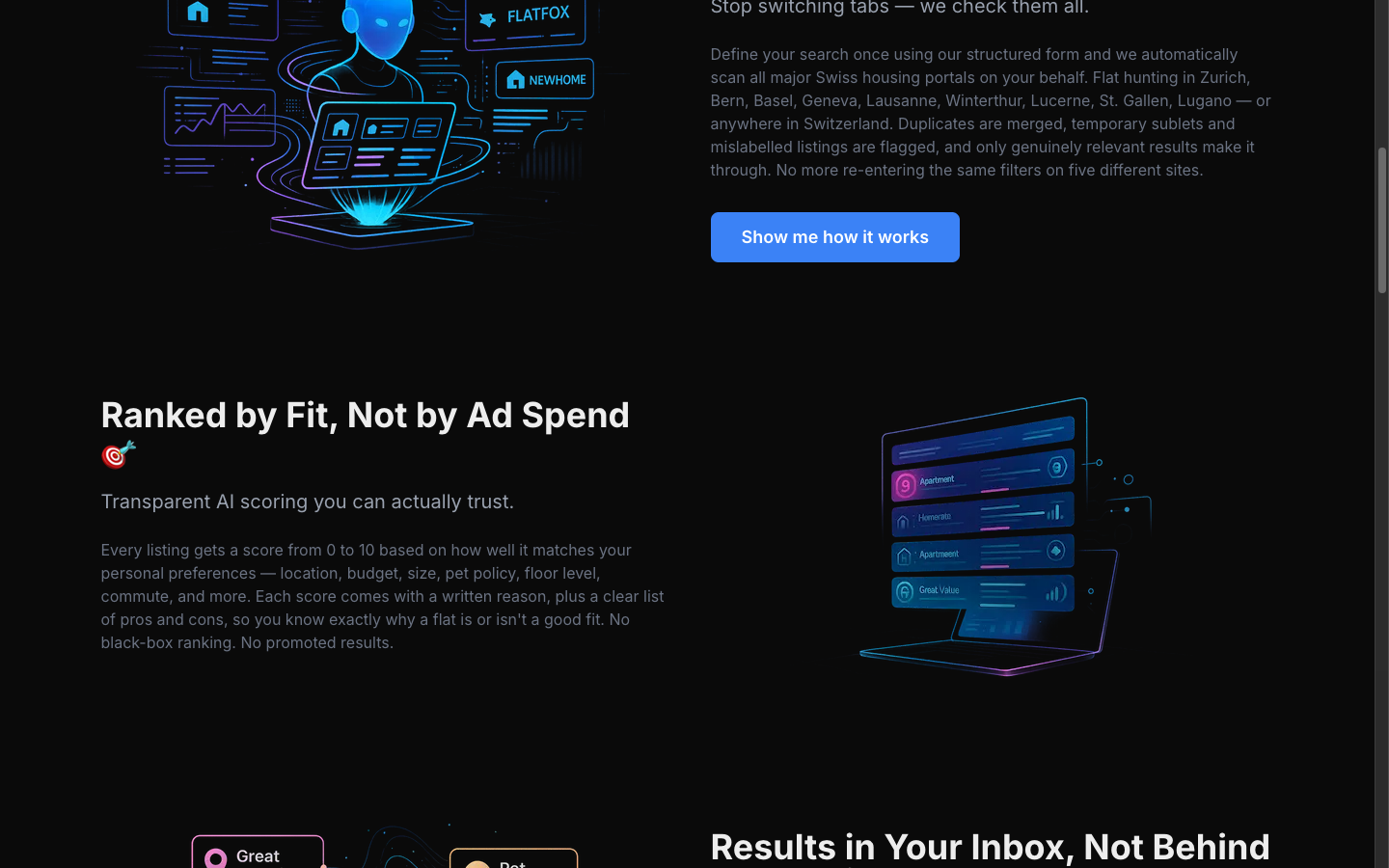
I have nothing against businesses earning revenue. But the result is that honest, fair, transparent ranking by fit is something you literally cannot buy on these platforms — because there is no fit signal in the first place. The platforms don't know what you want at the level of detail that would make ranking useful. They know "3 rooms, Zürich, max 2500." That's not a profile. That's a SQL WHERE clause.
4. The filter mirage
Try this: open Homegate and filter for "pet-friendly." Look at the results.
Some are genuinely pet-friendly. Some say "pets on request." Some say "no pets" in the German description but the checkbox got ticked anyway. Some say nothing about pets and the checkbox is just… on.
Repeat for: "balcony," "quiet location," "close to public transport," "newly renovated," "no carpet." The filters are a soft suggestion that the data underneath does not consistently support. The listing data on Swiss real-estate platforms is wildly inconsistent — different schemas, different conventions, free-text where there should be structure, structure where there should be free text. When the platforms try to filter on top of that data, they're filtering on guesswork.
The end result: the filters narrow your 800 listings down to 300 instead of 30, and you're back to scrolling.
5. The Nachmieter trap
In Switzerland, if you want to leave a flat before your contract ends, the standard escape hatch is to find a Nachmieter — a replacement tenant the landlord finds acceptable. If you find one, you can usually leave early. If you don't, you keep paying rent until your notice period ends.
The standard advice is: list on Ron Orp, Flatfox, Facebook groups. Brace yourself for 200 random messages, half of which are spam, the other half from people who haven't read the description. Sort by gut feeling. Forward the three that seem real to your landlord. Hope.
This is the outgoing tenant's version of the dossier ritual. Equally asymmetric, equally unfun.
6. The quiet tax on your time
Add it all up:
- Hours per week scrolling listings
- Hours assembling and updating dossiers
- Hours traveling to mass viewings
- Hours waiting for callbacks that don't come
- Cognitive load of remembering which of 23 flats you applied to and which one had the cold kitchen
Nobody talks about this as a cost. But it's a real one. The Zürich rental market quietly extracts a few hundred hours per year from anyone actively searching. That time has a value. It's just paid invisibly, by every applicant, all the time.
Why none of this is "normal"
Other rental markets have their own pathologies — wild price spikes, scarcity, broker fees — but the specific combination here is unusual:
- Highly inelastic supply (you can't easily build more flats in Zürich)
- High applicant-to-listing ratios (every desirable flat gets dozens of dossiers)
- Inconsistent data + opaque ranking on the platforms
- Cultural acceptance that the applicant does most of the work
The result is a market where the fit between flat and tenant — which should be the whole point — is the last thing anyone optimizes for.
What I'm trying to do about it
I built flat-finder.ch because I wanted, at minimum, the fit problem solved. Not the supply problem (I can't build flats), not the dossier problem (that's a regulatory question), not the Nachmieter problem (yet — it's on the roadmap).
But the which of these 400 listings should I actually look at? problem? That one I can solve. It's a ranking problem on top of a data problem, and both are tractable with AI and care.
If you're hunting in Zürich right now: try it. flat-finder.ch. Tell me what's broken. The next post in the series will walk through a real case study — a flat I actually found this way, with the actual Match Score and the actual numbers.
Until then: I see you, fellow dossier-printer. You're not crazy. The market is just like that.